
A closer look at the failure modes that quietly shorten motor life — and the thickener chemistry engineered to interrupt them.
Electric motors are often described as the most reliable components in an industrial plant. They run continuously, draw predictable current, and rarely call attention to themselves — until they fail. When the diagnosis arrives, it usually points away from the windings and toward something far less glamorous: the bearings.
Industry studies of electric motor failures consistently identify bearing-related issues as the leading mechanical cause of motor breakdown. And within that category, the root cause is rarely the bearing itself. It is the lubricant inside it — the wrong grease, the wrong quantity, the wrong relubrication interval, or a chemistry that simply could not survive the operating conditions.
To understand why grease selection matters so much in this specific application, it is worth looking inside the bearing itself, at the conditions the lubricant has to endure.
The Operating Environment Inside a Motor Bearing
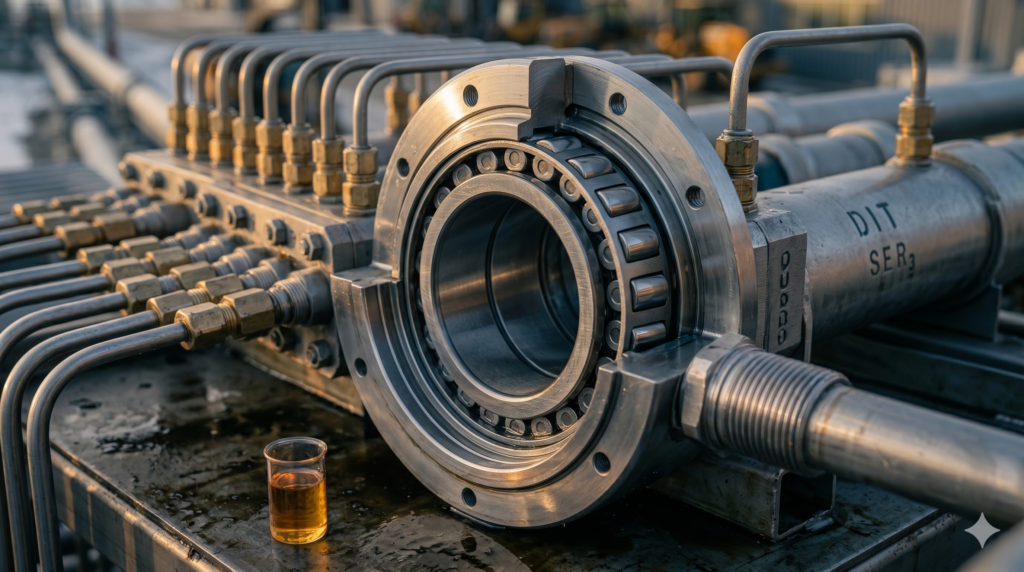
An electric motor bearing operates in a narrow, demanding envelope. Rolling elements move at high speed across raceways that may be only a few millimetres wide. The lubricant film separating those surfaces is measured in microns. Heat is generated continuously — both from friction within the bearing and from conducted heat off the motor housing and stator windings.
Temperatures inside the bearing housing can sit at 80–100°C in routine service, and rise considerably higher in motors operating in hot ambient environments, under heavy load, or with restricted ventilation. The grease has to maintain its lubricating film, its consistency and its chemical stability across all of these conditions, often for thousands of hours between relubrication intervals.
Three failure modes dominate this environment, and each is directly tied to the grease.
The first is mechanical breakdown of the thickener. Every time a rolling element passes through a zone of grease, it works the lubricant — shearing it, compressing it, and changing its structure. Over millions of cycles, a grease with poor mechanical stability softens, loses its ability to hold the base oil in place, and ceases to deliver lubricant to the contact zone.
The second is oxidation of the base oil. Sustained heat causes oil molecules to react with oxygen, forming acids, varnish and eventually carbon deposits. These oxidation products are abrasive, corrosive, and in many cases conductive — none of which belongs inside a precision bearing.
The third — and the one most specific to electric motors — is oil bleed and migration. All greases release some oil over time. That is part of how they work: the thickener acts as a reservoir, slowly bleeding oil to the rolling contact. But in an electric motor, excessive bleed becomes a serious problem. Released oil can migrate out of the bearing housing and into the motor windings, where it degrades insulation and contributes to electrical failure. A grease that lubricates the bearing perfectly but ruins the windings has not solved the problem; it has moved it.
Why Thickener Chemistry Is the Pivot Point
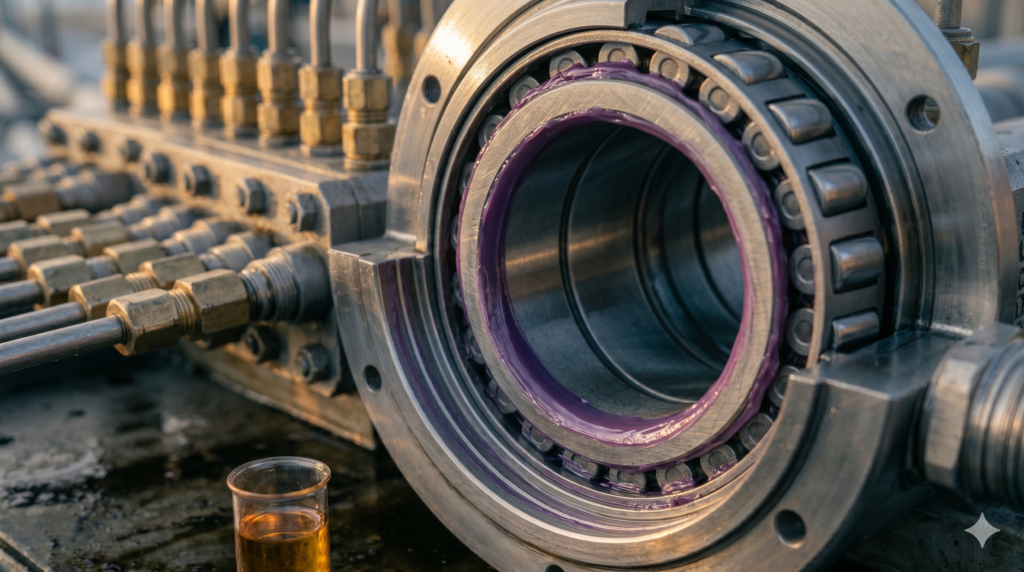
The thickener is the structural backbone of a grease. It determines how the grease behaves under shear, how much oil it releases over time, how stable it remains at high temperature, and how it responds to repeated mechanical work. For decades, lithium-based soaps were the default choice for general-purpose greases, including motor applications. They are reliable, widely available, and well understood.
But “reliable” and “optimised for electric motors” are not the same standard. Polyurea thickener chemistry was developed specifically to address the failure modes that matter most inside a motor bearing — and the difference shows up in measurable performance.
Polyurea is a non-soap thickener built from organic compounds rather than metallic salts. It contains no metal ions, which removes a category of catalytic activity that can accelerate base oil oxidation over long service intervals. Its molecular structure resists mechanical degradation under repeated working — the property that allows a grease to maintain its consistency through hundreds of thousands of bearing rotations rather than softening into a fluid that drains away.
Equally important, well-formulated polyurea greases exhibit very low oil bleed, which directly addresses the migration risk into motor windings.
How Monolec® Extend EM Grease 1282 Translates This Into Service
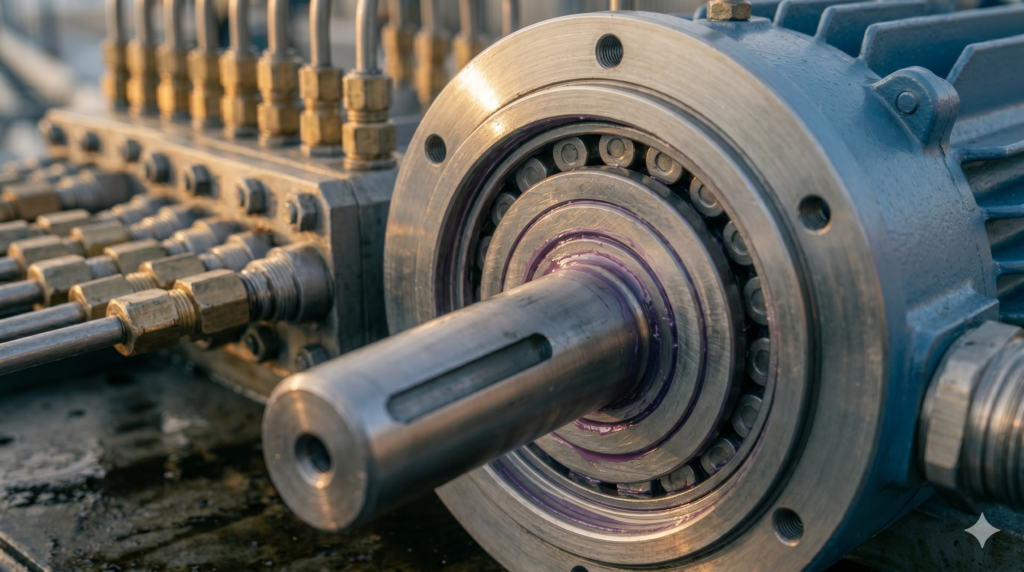
Monolec® Extend EM Grease 1282 from Lubrication Engineers is built around polyurea thickener chemistry and engineered specifically for electric motor bearings. The technical data tells the story of how each design choice maps to the failure modes described above.
Mechanical stability is verified through extended worked penetration testing. Standard worked 60 penetration registers at 280, with worked 10K penetration changing by only ±5% and worked 100K penetration by ±8%. In service, this translates to a grease that does not soften progressively under shear — the consistency the bearing receives at 10,000 hours is essentially the consistency it received at start-up.
Oxidation resistance is documented through ASTM D942 testing, with a pressure drop of less than 5 psi over 100 hours. Combined with an evaporation loss of less than 1.0% over 22 hours at 100°C and a dropping point of 280°C (536°F), the formulation is engineered to remain chemically and physically stable across the full operating temperature range of -23°C to 204°C.
Oil bleed — the failure mode most specific to electric motor applications — is held below 2.0% under ASTM D6184 testing (30 hours at 100°C). The grease releases enough oil to lubricate the rolling contact, without releasing enough to migrate into the windings.
Wear protection comes from Lubrication Engineers’ proprietary Monolec® additive, which forms a single-molecular lubricating film on metal surfaces. This film increases oil film strength without affecting bearing clearances, allowing opposing surfaces to slide past one another with reduced friction, lower operating heat, and less wear over time. Four-Ball Wear testing (ASTM D2266) confirms a wear scar of 0.5 mm under standard conditions.
The cumulative effect, in service, is a motor that runs cooler, draws slightly less current, and reaches its scheduled relubrication interval with the bearing still in healthy condition.
A Note on Conversion
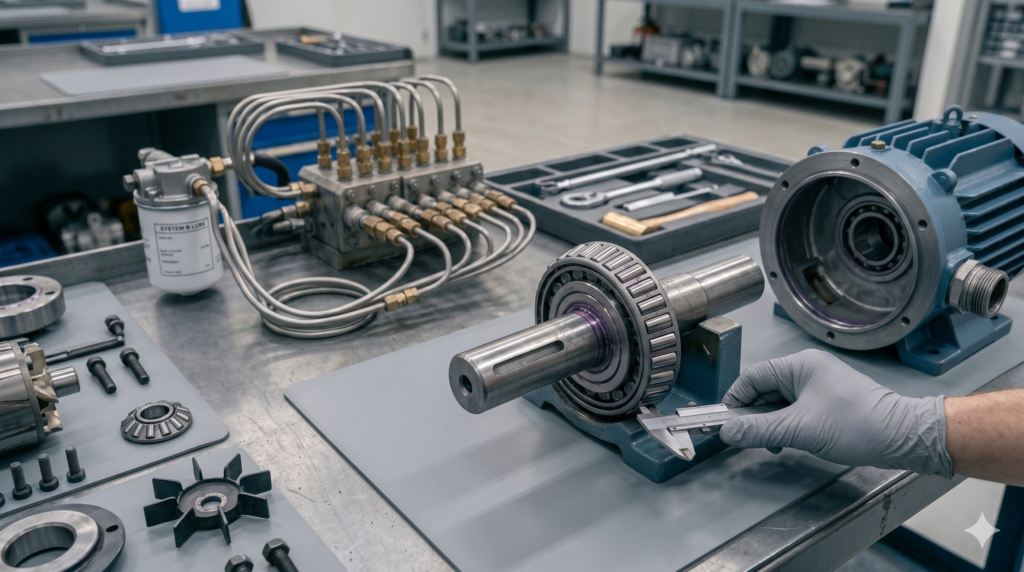
For plants converting from another grease, the most important detail is procedural rather than technical. Mixing different greases — particularly across thickener chemistries — can compromise the performance of both. Best practice is to disassemble the bearing housing and remove the previous lubricant before introducing Monolec 1282. Where disassembly is not practical, the housing should be purged with the new grease, the relubrication interval temporarily shortened, and the bearing closely monitored through the transition.
Done correctly, the conversion is straightforward — and the results are visible within the first service interval.
